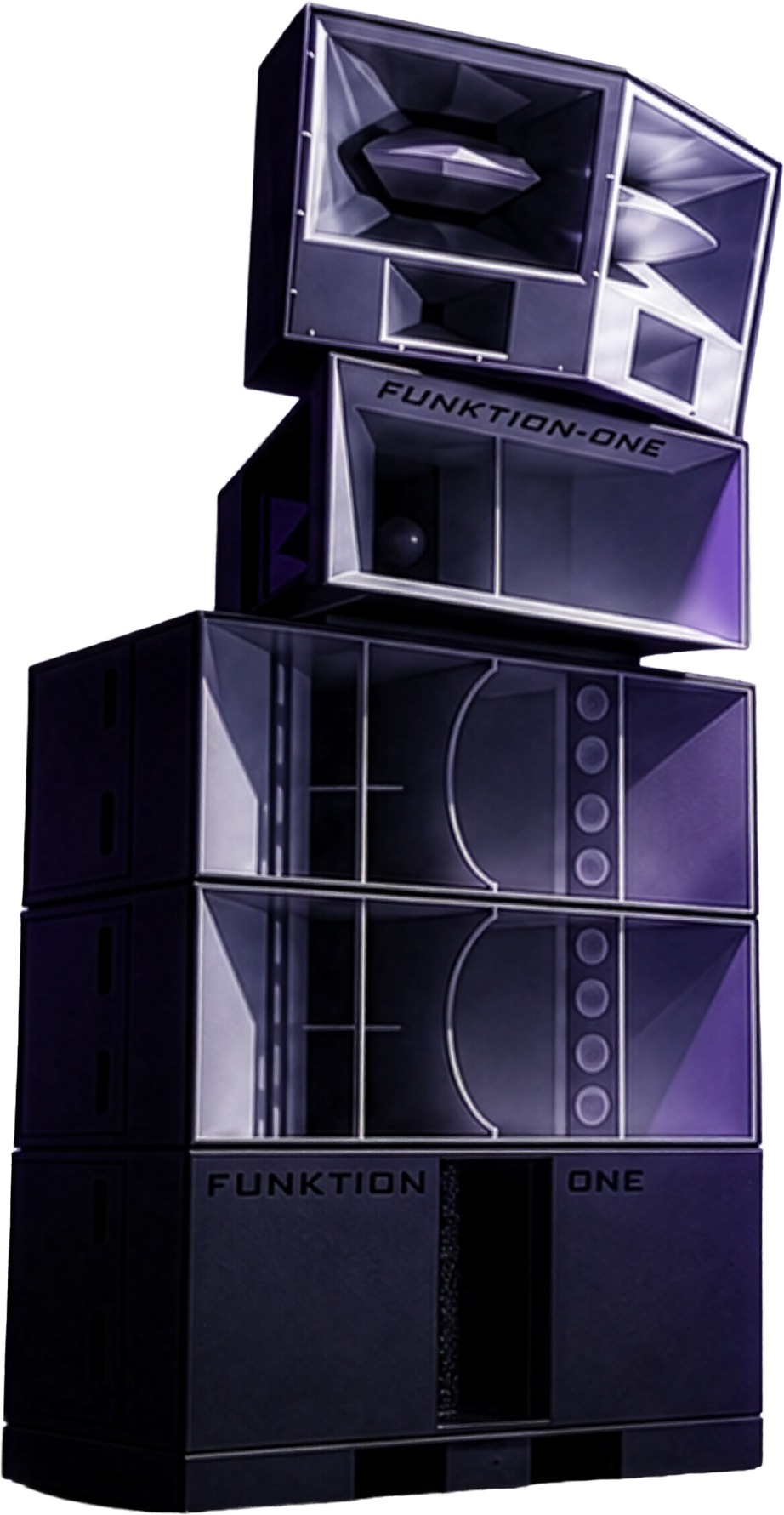
The Dance Stack is a visually unmistakable, horn-loaded system created for direct, high-energy connection between music and the dance floor. Violet Vibration owns the core components of an authentic Dance Stack configuration and deploys them as a coordinated system rather than a decorative stack of cabinets.
Every proposal starts with coverage and operational reality. Audience geometry, listening distance, room boundaries, subwoofer placement, stage position, noise limits, power, access, and program level all affect the design. A Dance Stack can be the right answer for an intimate club, a warehouse, or a focused festival environment, but the exact configuration should be chosen from evidence, not appearance alone.
The Violet Vibration configuration
The owned inventory includes two DS210 mid-high loudspeakers, two DS15 loudspeakers, four F218 Mk2 bass enclosures, two F218 Infrabass enclosures, and two F88 monitors. XTA DP226 processing and MC2 amplification complete the core signal and power platform. Final deployment can use part or all of the inventory according to the audience and room.
- 2 Funktion-One DS210
- 2 Funktion-One DS15
- 4 Funktion-One F218 Mk2
- 2 Funktion-One F218 Infrabass
- 2 Funktion-One F88 monitors
- XTA DP226 processing and MC2 amplification
Why system context matters
A cabinet model does not determine the listening experience by itself. Gain structure, crossover behavior, polarity, delay, physical alignment, source integrity, amplifier headroom, and limiting strategy all interact. We treat the stack, electronics, room, and operating plan as one system and verify it before doors.
Where the Dance Stack excels
The format is especially compelling in spaces where the sound system is part of the event identity and the audience gathers around a defined dance floor. Clubs, warehouse events, artist showcases, afterparties, immersive rooms, and focused festival stages can all benefit when placement and coverage fit the environment.
A responsible rental process
We protect guests, venues, artists, and equipment through a documented operating plan. That includes appropriate power distribution, safe placement, weather planning for outdoor work, cable management, reasonable level management, secure audience separation where necessary, and communication with the wider production team.